Work happenings this week (somewhat HTV-related, at least)

Written by Bob McCormick on 2/12/2011 01:20:00 PM

This past week saw significant SPDM use.  SPDM (also known as Dextre) is robotic equipment that was used to relocate external equipment from the Exposed Pallet (brought up to the ISS via the HTV) to the SPDM itself (temporarily). 

This link details a lot of the operations that were performed.

Next week, the HTV will be relocated by the SSRMS, from the Nadir (lower) Node 2 port to the Zenith (upper) Node 2 port.  It's the first time an HTV has been relocated.  It's needed because the next Shuttle flight is bringing up a module in the payload bay - and having the HTV on the Nadir port would block the ability to remove that module from the payload bay.  Thus, the HTV will be relocated back to the Nadir port after the Shuttle flight.

What I think about Obama's proposed NASA budget

Written by Bob McCormick on 2/09/2010 10:51:00 PM

Let me answer by analogy ...  I'm sure you can fill in the blanks.

I now live in east HoustonI used to live in west Houston.  It's no secret that I used to live in Dallas and I've traveled there before

I liked Dallas.  Dallas is not a perfect place, but I think it's a good thing that I could prove that I could live there like I can live in Houston.  Houston is also not a perfect place, but having people in two places is a good idea, because it would be bad if there was a natural disaster in Houston, and people only lived nowhere but Houston. 

I also don't think I need to make Houston a perfect place before I decide I need to go to Dallas, just like I didn't think I needed west Houston to be perfect before I moved to east Houston.

So someday, I'd like to go back to Dallas -  maybe for short visits, maybe to live there. Certainly others will want to go to Dallas, whether I go or not.

Dallas doesn't have everything Houston has, but it does have a few unique things that Houston probably doesn't have.  So, going to Dallas - either to visit for periods of time, or to live there - has its own merit, simply because it isn't Houston.

I'm sure that when I want to go to Dallas, I really want to go to Dallas.  I could go there by going through Austin, San Antonio, Waco, or even out of state.  All those places also have merit, but Dallas has its own unique merit, and I could get to those other places from Dallas as I could from Houston - maybe even easier than from Houston.

When I decide I want to go to Dallas, I have a number of choices on how to get there.  I could drive, I could take the bus, I could fly in an airplane.  Clearly, how I get to Dallas dictates what I can do once I get there.  But the decision on how to get there is different than the decision on going there in the first place.

My current car has high mileage, so it might not be so reliable to get me to Dallas (and back).  But, it will allow me to drive around Houston.  So, assuming I want to go there by car (because going there other ways doesn't allow me to do the stuff I want to do), I might want to buy a new car, or a used car.  If no cars existed that were reliable enough to get me to Dallas and back, I might build a car - or hire someone out who could build me that car.  I'd probably go with the least expensive option.  But notice - I needed to decide to go to Dallas before I could even decide on whether to build or buy a car! 

Whoever builds the car needs certain technologies that assured that I could get to Dallas, do the stuff I want to do while I'm there, and get me back.  This would include good tires, some sort of engine to allow the car to be motorized, heating (and most importantly, air conditioning!  This is Texas, after all) ... the kinds of things that will make it more likely for any car to get to Dallas and back, or allow me to stay in Dallas.  I could test out those technologies by driving my car around Houston (and that idea has merit).  But deciding to test those technologies by driving around Houston, even if they could be used to drive a car to Dallas, is different than deciding to go to Dallas (or Austin/San Antonio/Waco, for that matter)!

In the final analysis, deciding to go to Dallas is the most important decision.  How we go to Dallas, or what technologies to use in our vehicle to go to Dallas ... those decisions are important, but they are not (literally)the driving decision.  Even WHEN I get to Dallas is not tremendously important (especially from the perspective of getting there just to get there ... after all, I've been there before), as long as it is within a reasonable time frame for me to do the new things I want to do when I get there. And if I focused on those decisions, while ignoring the question about what to do with them once they are developed, I would be showing a lack of vision.

Other thoughts here (much of which, I agree with).

P.S.  Another good analogy ... "Operation Overlord Canceled"

Lunar landing "hoax" - enough already!

Written by Bob McCormick on 7/20/2009 10:15:00 PM

With the 40th anniversary of the 1st landing on the moon, you'd think that most folks would finally drop the lunar hoax conspiracy theory.

If they did, I think I'd shout "Whooppie"!

Or maybe I should just shout ... "Whoopi"?

You see, Whoopi Goldberg did it again. On the July 20th taping of ABC's "The View", Whoopi insinuated that NASA faked the moon landings, based on the obviously fictional movie "Capricorn One". Even Barbara Walters had to set her straight, with the weak "evidence" Whoopi Goldberg presented, since the landings were done SIX TIMES.

But in my opinion, I think the coolest "evidence" (as if I needed more) of the Apollo Lunar landings came from NASA's next attempt to get back to the Moon. Three days ago, NASA's Lunar Reconnaisssance Orbiter provided detailed images of the Lunar surface - images that are much more detailed than could have been obtained back in the Apollo years. As you can see from these photos, the LRO flew over the old Apollo landing sites, capturing images of the lunar descent stages still sitting on the landing sites!

Perhaps Whoopi Goldberg and her pseudo-intellectual "lunar hoax" crowd can argue with those images.

HAT TIP: Mark Whittington/Curmudgeon's Corner and Debbie Schlussel

Welcome back to the ISS, Mike Fincke!

Written by Bob McCormick on 10/14/2008 09:34:00 PM

Work was great yesterday. I got to see the 17 Soyuz crew dock to the International Space Station, which they managed to do about 5 minutes ahead of schedule (and since I happen to manage and monitor that schedule, I should know ...).


The 17 Soyuz crew consists of the new Expedition 18 Commander, Michael Fincke, as well as the Expedition 18 Flight Engineer Yury Lonchakov (who is also a veteran on the ISS, albeit with a visiting Shuttle). It also includes the 17 Soyuz Visiting Crewmember Richard Garriott (who is the son of the Apollo and Skylab Astronaut Owen Garriott).


Soon after the docking and ingress, the crew had a public relations event with visitors at Mission Control in Moscow (where, naturally, the docking was also being closely monitored). There, Mike's wife Renita and his children (Chandra, Tarali - who was born on Mike's first tour to the ISS, and Surya) were able to speak and see Mike again on orbit.


After my last experiences with Mike on orbit, the whole thing brought me a sense of deja vu. I'm definitely looking forward to his latest upcoming expedition.

———————————————————————————-
Related links:
Space.com, New Crew, Space Tourist Arrive at Space Station

The best space news last week

Written by Bob McCormick on 10/02/2008 03:43:00 PM

I personally think we had great news from the “space biz” last week.

It wasn’t the Chinese mission (although that was good).

It wasn’t the ATV reentry (although that was good, too)

It’s not even the funding that Congress & the President will provide for more Soyuz vehicles (which was needed - but they probably held their noses while they signed, given the political tension with Russia lately) …

No - the best news was the first launch of a private rocket. Assuming they can repeat the task, it is a paradigm shift for how low Earth orbit access can be done.

Way to go, Spacex! Definitely better results than the last time I mentioned Spacex!

———————————————————————————-

Related links:

Digg.com: The Chinese Space Walk

SPACE.com: European Spaceship’s Death Plunge Caught on Film

Chair Force Engineer: For SpaceX, a Golden Opportunity

Commercial Space Watch: National Space Society Statement on SpaceX Falcon 1 launch

Digg: Space X Did It — A Private Rocket is in Space!

Space.com: Countdown Coverage: SpaceX’s Fourth Falcon 1 Launch

Spaceports: FALCON-1 MAKES HISTORY: GOES ORBITAL and MUSK CELEBRATES!

Slashdot: On Fourth Launch Attempt, SpaceX Falcon 1 Reaches Orbit

Spaceports: Orbital Science Corporation’s Taurus-2 May Seek Human Launch Rating!

One of the top ten ...

Written by Bob McCormick on 6/20/2008 11:06:00 PM

ISS considered one of the top ten satellites orbiting the Earth (includes the Moon)

What if he does show up with it when he says he will?

Written by Bob McCormick on 6/18/2008 11:35:00 AM


According to this article, SpaceX and Elon Musk will attempt another countdown attempt sometime between the end of this month to the beginning of the next.

As I've said before - great! I hope they're successful.

On an equally important note: as some of you know, there is currently a planned gap between the retiring of NASA Space Shuttle flights and the start of NASA's successor vehicle, the Orion, of anywhere from 3 to 5 years (all depending on governmental funding). The Orion is designed similar to an Apollo capsule, but larger: it's meant to carry 4 crewmembers. The vehicle is boosted to orbit on a Solid Rocket Booster and External Tank designs based on Space Shuttle efforts.


When NASA is ready again for missions to the Moon, another follow-on vehicle (Ares V) will be used to lift lthe Altair Lunar Lander to orbit. Ares V is also designed around more SRBs and the Shuttle's External Tank. Orion and Ares V will rendezvous and dock with each other, and then go in tandem to the Moon. But before the Lunar missions can start, NASA will use Orion by itself to keep the crew on the Space Station.

But what to do about the Space Shuttle to Orion launch gap, and the need to have crews on the ISS in the meantime??? Currently, NASA is dependent on the Russian Soyuz vehicles to provide the "lifeboat" function needed on ISS. And there's an issue with the Soyuz vehicles - the last two vehicles used for returning the crew to Earth have undergone problematic "ballistic reentries",which expose the crew to much greater g loads then the nominal entry profile (as well as other potential risks). So, "staying the course" may have technical risks above and beyond Russian launch dependency.

Enter SpaceX and Elon Musk. They are currently building a vehicle under NASA's COTS program which will provide unmanned logistics support (propellant, food, water, etc) to ISS. However, the COTS program has a possibility of requesting a human-rated vehicle - which NASA is currently studying whether to do or not. To make things more interesting, SpaceX's CEO has already stated that he could "eliminate" the gap.

Now, I am not working with COTS in any way, so I have no true technical insight as to whether Musk's statement is a boast or a highly probable event. But what if he does show up with a workable, human-rated vehicle in 2011? What of all the design efforts into Orion - and why would NASA need it 4 years later?

It makes me wonder whether the $ being spent on Orion might be better programmed straight into Ares V.

P.S. - Here's a neat video of the proposed SpaceX/Dragon rendezvous and docking for ISS. Check it out!

The boss is right ... and so is Neal DeGrasse Tyson

Written by Bob McCormick on 5/23/2008 06:35:00 PM

My boss forwarded on to me a video of Neil DeGrasse Tyson & his views on Human Spaceflight.

Granted, I'm biased, but I agree w/Dr. Tyson (and by extension, my boss).

"So, Mr. Flight Controller guy, Where's all the NASA space posts?"

Written by Bob McCormick on 3/28/2008 06:27:00 PM


Good question.

Let me tell you what I will blog about and what I won't blog about.

I WON'T blog about heavy-duty stuff that I do at NASA. Yes, the work can be intense, but I also am doing this for a living. I will not be blogging about what I might have done on any particular week I am on console (other than in generalities). I MOST ASSUREDLY will not be blogging in any gossipy-sort of stuff - so even if I think Flight Director X is a flake or Astronaut Y is a jerk or co-worker Z is a bozo, you won't be reading about it in this blog.

Last time I checked, NASA has it's share of flakes, jerks, and bozos (and always has) - they are not unique relative to any organization of similar size. The jerks, flakes, and bozos are the vast minority and their antics do not require or deserve my reiteration here. Besides, I'm sure sometimes they think I'm a flake, jerk, and bozo - and sometimes, all at the same time. And who knows - they may be right!

I ALSO WILL NOT be blogging (at least, not directly) about any large-scale NASA policy. As many of the NASA folk would say, those decisions are "way above my pay grade". No sense ruminating about how they might not be my favorite decisions.

I WILL blog about what I see going on in the alt.space world. I think that what is happening there can lead to a renaissance (I know that's not the appropriate word, but you get the point) for the US aerospace industry and for our chances of making any kind of scaled-up spacefaring civilization.

That doesn't necessarily mean that NASA's doing the "wrong thing". From what I can tell, the alt. space efforts and the NASA efforts are not mutually exclusive - they are not an "either/or" proposition. As the Chinese might say, "Let a Thousand Flowers Bloom".

My main goal is not necessarily on how I personally can be an Astronaut. I applaud others who have this goal; however, my goal is focused on how to facilitate the space environment so that the probability of actually getting there goes up for everyone (of course, myself included). It may not be my generation, but it may be my kids' generation - if we can get our act together now.

I was on console when Bill Shepard was launched into orbit, as part of the first Expedition to ISS. On that day, as on other similar days, an American flag was raised on the roof of Mission Control. That flag is a symbol to remind us that there are Americans in orbit. The goal our FCT established that day was to assure that, from here on in, there will always be an American in orbit.

It's a hard goal to attain (and it takes forever to verify that you've done it!), but one I think that is worthy.

Back from Elvis-land ...

Written by Bob McCormick on 5/11/2007 08:31:00 PM

... not that I even saw Graceland, or anything Elvis-like...

I had too much catching up to do with my brother and sister, parents, aunts, uncles, and cousins.

And when I came back, I had 3 days worth of console ops, with some interesting replanning going on.

Congratulations again Mike and Halle!

Dang! Just missed Stephen Hawking at Mission Control!

Written by Bob McCormick on 4/23/2007 09:25:00 AM


I headed to work this week (actually, at the very tail end of this weekend - 11PM Sunday) to support 5 consecutive days of overnight ISS Flight Control Team console operations.

One of my shift coworkers, Mike Allyn, was apparently in Mission Control earlier, and was privledged to meet Dr. Stephen Hawking, who was being given a tour by Dr. Bob Dempsey, LEad Increment Flight Director for Increment 15.

I just missed meeting Dr. Hawking by just a few hours!

Bummer!

Go SpaceX!

Written by Bob McCormick on 3/26/2007 10:50:00 PM

Last week, while I was supporting ISS operations from the console, I had the good fortune to see (via the web) the first semi-successful launch of the SpaceX Falcon I rocket from Kwajalein atoll in the South Pacific.

I call the the launch "semi-successful" because the payload failed to achieve orbit. The rocket, however, did manage to reach second stage and was about 1 minute away from achieving orbit when SpaceX lost telemetry. (You can see a replay of the entire ~5:30 of rocket ascent here). SpaceX is looking into the reasons why it failed to achieve orbit. Some folks are speculating that it is related to the first stage bumping the second stage bell after separation - you can see this more clearly from the images here.) Regardless of the failure, SpaceX's CEO, Elon Musk (developer of Paypal), has declared the launch a "90% success" and is confident that he can get his next two launches (with paying satellite customers) to orbit.

Why do I bother blogging about this? Why is this important?

Because ...

1. Falcon 1 launches are being touted as costing a fraction of what similar launches would cost
2. SpaceX is planning on developing a larger rocket (the Falcon 9) with similar cost-cutting approaches, and
3. NASA is attempting to procure SpaceX (and Rocketplane Kistler) unmanned launches to supply logistics (spare parts, water, food, etc.) to the ISS in the next several years.

If SpaceX and/or Rocketplane Kistler ultimately become successful, space launches may become significantly less expensive - and space operations costs will come down. The net result may be a significant increase in space operations.

I'd be a fool if I were against that!

Go SpaceX!

alt.space - background

Written by Bob McCormick on 10/10/2006 10:49:00 PM

This is the first of a series of blog entries I will be devoting to a general topic called "alt.space". In this series, I hope to touch on the history of alt.space, who is involved, and what they are doing. I'll also be interjecting my thoughts/opinions into where I think things are headed. (Hey - it's my blog, so it's my rules!)

For those of you who don't know, "alt.space", as defined in wikipedia, is "...a community of relatively new aerospace companies working to develop low cost access to space or spaceflight technologies, and low cost spaceflight technical and policy advocates". This is the first of (hopefully) a series of alt.space blog entries, where I'll attempt to share what I know (which may not take long!).

The alt.space community is a relatively small, but perhaps the most important, aerospace community in the United States. These companies are collectively and individually working in areas that could potentially significantly lower the cost of launching payload weight to orbit. Current costs for payload weight to orbit vary by the payload and by the vehicle it's flown on. However, a good estimate for payload weight cost to orbit is approximately $10,000/lb - which is more than what a pound of gold costs. Historically, excluding commercial telecommunications companies, only government agencies (e.g., NASA an Dept. of Defense in the US) have been able to justify the cost.

Most alt.space companies are working on projects that decrease payload weight to orbit costs by an order of magnitude (that is, down to approximately $1000/lb). At these costs, it is envisioned that many more customers will be attracted to launch payloads to orbit. This method was useful in development and promotion of the Ansari X-Prize. The X-Prize was to be given to the first company which could develop a vehicle which could deliver a standard payload (with pilot) to orbit, and perform the same feat within two weeks, without removal of a significant portion of the vehicle. Burt Rutan and Paul Allen (co-founder of Microsoft) formed Mojave Aerospace Ventures and won the $10 million prize on October 4, 2004. They are currently forming a joint venture with Sir Richard Branson, forming a new company called Virgin Galactic. The State of New Mexico has pledged approximately $200 million to develop an area between Las Cruces and White Sands as a Spaceport that Virgin Galactic can use to develop a suborbital tourism industry, with regular suborbital flights into space. Their efforts will be regulated (under special regulations) with the FAA.

I personally think that alt.space community holds quite a bit of economic potential. I'll be blogging more about where I think alt.space is, and where it's headed - so stay tuned!

White and Nerdy

Written by Bob McCormick on 10/02/2006 11:36:00 PM

Must be seen to be believed. I don't have cable, and I think this has been on there some time, so I guess I'm behind the times ... again ...(sigh)

Folks at work were reminded of each other when they saw it.

Thanks for sharing, Ms. Minimiles!

Last week's funniest ISS console ops story: "Sucky Pants"

Written by Bob McCormick on 10/02/2006 11:00:00 PM

Well,

I managed to survive another week of ISS console ops. As I said in an earlier post, I had to work the "graveyard" shift. The major thing that occurred last week was the overlap of the next Expedition crew. Expedition 14 - Michael Lopez-Alegria and Mikhail Tyurin), and their visiting crewmember, Anousheh Ansari, arrived with the Soyuz launch and docking during the previous week. The previous Expedition crew (Expedition 13 - Pavel Vinogradov and Jeffrey Williams), along Anousheh Ansari, took the existing Soyuz back down to Earth this past Friday. Thomas Reiter, who came up on STS-121 and was with the Expediton 13 crew, will stay with the Expedition 14 crew but will return to Earth before them, and be replaced by Sunita Williams (no relation to Jeffrey Williams) on a later Shuttle flight.

The funniest thing happened before my Wednesday shift. As FCT shifts hand over from one shift to the next, each Flight Controller develops log entries during their shift and note the significant work and operations that the next shift will have to execute. As a part of that process, I asked my counterpart what were the significant events that were to occur on orbit during my shift.

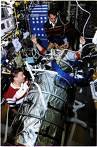
As it so happened, some of the Expedition 13 crew were undergoing something called a "Lower Body Negative Pressure" protocol, for a period of time. It looks something like the picture here. The idea is for the crewmember to jump into a kind of "bag" which has some of its air pressure taken out, relative to what the upper body is experiencing. This helps draw blood down to the lower part of the body, which helps crewmembers on long-duration zero g flights, as their circulatory system hasn't had a gravitational pull on it, and helps their acclimation to the regular gravitational pull on their circulatory system when they arrive back on Earth.

Anyways, the LBNP has a legitimate technical need. Nevertheless, as I reviewed the activities on the plan, I mentally shortened the LBNP activity to "Sucky Pants".

Problem is, I said that with my outer voice.

The Ops Planner I took the handover from thought it was the. funniest. thing. ever. And come to think of it, she was right! She shared what I said with our back room support (on a private voice loop), who agreed.

After our quick individual handover, the oncoming FCT shift normally spends a quick session on one of the FCT loops reviewing, Flight Controller by Flight Controller, the significant events and items the FCT needed to do for the shift. While I was doing my part, the offgoing Ops Planner and the backroom were triple-dog daring me to call the activity "Sucky Pants". I was tempted, but I did not want to make a career-limiting move.

So, I thought it would be better to share it with you, my steadfast and loyal blog readers.


"Sucky Pants" ... :*)

Control Room changes and plaque hangings - and back to FCR1!

Written by Bob McCormick on 9/30/2006 02:11:00 AM

This past week, I supported ISS mission operations on the “Orbit 1” shift (from 11PM to 8AM local Houston time). At the end of my week’s operations (yesterday), I decided to hang around Mission Control for the privilege of watching the STS-115/12A mission plaque hanging, and the retirement of the Blue Flight Control Room (BFCR).

Mission plaque hanging is a long-standing tradition within Mission Operations. If you visit any of the main Mission Control rooms in Houston, you’ll see mission plaques hanging on the side walls of each main Mission Control room. These mission plaques are representative of each mission supported within the room, reaching all the way back to the Gemini missions. At the end of each mission, the lead Flight Director selects a Flight Controller who exhibited the most poise and professionalism (usually under duress) with the privilege of climbing the ladder and “hanging the plaque” in Mission Control.

For this past mission, four Flight Controllers were given the honor – for two plaques within the White FCR (where the Shuttle Flight Control team works), and two within the Blue FCR (where the Space Station Flight Control team works). For this past mission, lead Flight Controllers for the INCO (Instrumentation and Communications officer) team and PDRS (Payload Deployment and Retrieval System – basically, the Robotics officers) hung the plaques in the WFCR. In the Blue FCR, the Assembly and Checkout and PHALCON (Electrical Power) Lead Flight Controllers hung the plaque.

After the plaque hangings in the BFCR, another special ceremony was added. Normally, during the plaque hanging ceremonies, the ceremony itself has to occur while Space Station operations are occurring. The event can get unnerving, as ~12 Flight Controllers are maintaining Space Station operations while ~40 people from a previous mission come into mission control and hang a couple of plaques on the wall (usually the events are scheduled during a light operations timeframe, to keep the ceremony from unnecessarily hampering space operations).

However, this time, the ISS was being operated out of the WFCR - nobody was in the BFCR! This is because we are moving ISS operations out of the BFCR to “FCR1”. FCR1 is actually the room where the Apollo, Apollo-Soyuz, Skylab, and early Space Shuttle missions were flown. (Tourists don’t need to worry – a second BFCR has been maintained 1 floor above FCR1 which is in essentially the same condition as it was for the Apollo missions.) FCR1 has been refitted with more modern computer equipment, and on 6-October, we plan on operating the ISS from it.

Back to the future!

Back to console ops - and Steve Gibson is "the man"

Written by Bob McCormick on 9/24/2006 08:36:00 PM

I get my turn again this week on console, working the graveyard shift again.

Actually, I should have started my work last night. However, I misread the console manning plan!

Normally, we staff the graveyard shift 5 days a week (Monday through Friday). The shift actually starts 1 hour prior to the beginning of the day - so my "Monday" shift starts at 11PM on Sunday and continues through 8 AM that day. I noted how I was on the graveyard shift but missed that it actually started Sunday - which is the way we normally staff for a Soyuz crew rotation mission (like we currently have).

Normally, this wouldn't be a problem. However, I had 4 tickets to the Houston-Oklahoma State game - and the kickoff would be at 8PM. Remember what I said about the Houston-Rice game?!? I wouldn't be home until 12:30 AM ... 1.5 hours after my first shift was to start!

I figured this out at 3 PM on Friday. Time to panic!

But after 10 seconds of panic, I calmed down & thought out what to do. First, call the CEO (Ms. McCormick) & tell her the bad news. As I describe it to her, it dawned on me that I might be able to find an Ops Planner still in the office to "pinch hit" for me for one shift. It was late Friday, but it was worth a shot. So I got off the phone with the CEO & attempted to find someone who I might be able to "cut a deal" with.

Enter Steve Gibson (a.k.a. "the man").

Steve was the Lead Ops Planner for Expedition 13, and had just earlier come off his duties at that position (with the Soyuz docking to the ISS). I explained my situation and asked him if he could help out - he said he'd have to check with his wife (I understood that - I have to check with the CEO on those things, too). After about an hour or so, Steve gave me the "thumbs up". Yahoo!

So far, everything has worked out. Oh, and Houston beat Oklahoma State, 34-25 (more blogging on that later).

So now I'm getting prepared for the majority of the Soyuz joint mission - Expedition 13, Expedition 14, and Anousheh Ansari.

STS-115: Well done!

Written by Bob McCormick on 9/21/2006 11:01:00 PM

My apologies for not blogging this sooner, but ...

STS-115 came out great!

The crew was able to deploy the P3/P4 truss segment, carrying the new Solar Arrays. The Solar Arrays and their associated thermal radiator were deployed. Deploying big mechanical things on the ISS always looks cool, but deploying the Arrays is signficant - it starts us down the path of having enough electrical power onboard the ISS to support the Japanese and European laboratory modules (slated to be installed in the coming flights).

This mission was not without its glitches - some minor, some potentially major (such as the bolt loss during the EVA, and the liberated debris found floating on the day prior to the first reentry attempt). I'm confident that folks will be looking to understand those anomalies and come forward with recommendations to mitigate or eliminate them.

In the meantime, check out this NASA link - these pictures say a thousand words.

Congratulations to the STS-115 crew and FCT! Good job!

How to get a job as a NASA flight controller

Written by Bob McCormick on 9/21/2006 07:40:00 PM

Due to somewhat popular demand, I've decided to post this.

These are the most common steps it takes to get a job as a NASA flight controller in Houston (i.e., for NASA human space flight). The amount of time it takes to become certified is a function of the organization's needs and your capabilities. What I've listed here is the basic path for flight controller certification.

1. Study well in High School and College. Your emphasis should most likely be in Science and Mathematics, as these provide the best foundation for working at NASA and in Aeronautics in general. However, you should also strive for a well-rounded education: English, Foreign Languages, and Humanities-based course work is also vital, and also should be studied well.

2. If you are not one, become a US citizen. Yeah, I know this isn’t as easy as it sounds. Nevertheless, you likely will not be hired to work in Mission Control in Houston. The only exception is if you work for an International Partner for the International Space Station (Russia, Japan, Canada, or one of the European Space Agency member countries) - and then, only in a limited capacity (i.e., to positions assigned for those Partners or as liaisons to control centers in the other Partner countries.

3. When in college, obtain a degree in something that correleates to a position in Mission Control. (Here's a link that describes all the positions.) This generally means that you should major in Engineering, but several other areas (Mathematics, Physics, Chemistry, Computer Science) are acceptable for many positions. Some positions are suited for specific areas (examples: Pre-Med), but most of the others will work with an Engineering or science degree program. It's possible to get a flight controller position without an Engineering/Science degree, and several have, but they are generally rare.

Note 1: For Engineering, your degree needs to come from an accredited school. (Don't get too cheap - your career depends on getting this right.)

Note 2: Technology degrees are not Engineering degrees (even "Engineering Technology" degrees). If they were, then there would be no need to offer the two different types of degrees.

4. Actually get the degree. And by all means, do not come close to getting it and miss it by a class or two, then whine about how "all the people with Engineering degrees get the good jobs and I don't". If you're that close to finishing, just finish - stop trying to imply that the last few courses don't matter (and then attempt to build a career around that).

5. Apply to the organizations that are responsible for providing mission controllers. Currently, this includes NASA as well as several NASA contractors - the United Space Alliance, Barrios Technology, Cimarron (GC), and Wyle Labs (BME/Surgeon). Indicate that you wish to work in mission control. Your ability to be hired is dependent on your track record in college, and the needs of the organization. (Note that most of the organization knows it has openings that are generally tied to the Fiscal Year, which starts in October.) The organizations needs will drive your schedule to determine your certification as a flight controller.

6. After you are accepted, you will be expected to undergo training. Most controllers go through a series of classes called “Training Academy”, which can take upwards of 2 months.

7. Work with your branch to determine how you can get certified in a back room position. Almost all of the flight controllers that you see on TV in mission control have at least one person that assists them in particular tasks in another room away from the main room. These positions are considered “back room” flight controllers – and the “front room” controllers could not do their job without them. Virtually every flight controller in mission control has been a back room flight controller at some point.

8. At some point during the back room certification process, you will be required to undergo a medical evaluation and associated certification. This certification is the equivalent of an FAA Flight Controller medical certification and needs to be kept current with your other work-related certifications.

9. As you continue further specialized training for your position, you will be required to review a lot of technical material and participate in simulations. The simulations can be held with either one controller or an entire Flight control team (and astronaut crew). Certain conditions will be put into the simulation that will test your ability to respond.

10. Assuming you respond to the training and simulations correctly, your branch will certify you to be a flight controller. Congratulations!

11. Further tasks, training, and simulations are usually required before you will be certified in the main Flight Control room, which will also be driven by the organization’s needs.

Yesterday's console ops

Written by Bob McCormick on 9/19/2006 07:38:00 PM

Late last week, I agreed to substitute for the Ops Planner scheduled for mission support this week. I was only needed for Monday (yesterday), during what is called the "Orbit 2" shift (which is 7AM to 4 PM - basically, regular day hours). Since the Shuttle had just undocked from the ISS the day before, the ISS crew was slated for some off-duty time, so I figured the day would be relatively quiet.

Wrong again!

When I came into Mission Control, I went to the MPSR (Multipurpose Support Room). It's an area with other Flight Controllers that provide support to the Front Room Flight Controllers that most people see on NASA TV. I normally leave my headset there - when I pick it up and drop it off at the beginning and end of my shift, it gives me some time to talk face to face with some of the Flight Controllers helping me during my shift.

As I was picking up my headset, I turned on one of the TV monitors, and it showed Astronauts John Phillips and Shannon Lucid at the CAPCOM console, intently looking at their monitors. Since the TV volume wasn't on, and the Flight Controllers were listening to conversations through their headsets (and not through speakers, which would have been unusual anyway), I didn't really know what was going on. Then, one of the Shuttle Flight Controllers said "Yes, that would be a reason to declare emergency". I didn't piece together what he meant, since I couldn't hear the loop conversations. Then, I spoke with one of the Station Flight Controllers from the previous shift, who said, "Bob, you'll have a really interesting shift here. The crew's reporting smoke in the cabin and we've declared a spacecraft emergency!" I rolled my eyes and headed down to the Front Room to see what was going on.

I started taking my handover from the previous Ops Planner, and as I was doing so, someone in the room said "You're on CNN now". Good thing my tie was straight! It turned out that the crew had problems starting the Russian Elektron Oxygen Generator (it has had problems before), and this caused a smoke-like smell in the Russian portion of the ISS. The crew had turned the Elektron off, retreated towards the Soyuz, gone on surgical masks, and were taking cabin readings to determine the chemical makeup of the cabin air.

In times like these, it's best to remember what your job is and how it fits into the entire operation. I am an Operations Planner. I am responsible for developing and maintaining the overall execution plan for the ISS. My job is not to necessarily respond to every systems emergency - there were plenty of other console positions doing that job. Therefore, my job was to possibly consider the plan changes - while at the same time, help finalize the nominal plans. I had to assume that the crew and FCT would and would not be able to recover from the emergency. However, I had very little to do with recovering from the emergency, so I interpreted my job with staying out of the way until the right members of the FCT and the crew could do that job.

In the end, the crew and FCT did the usual superb job. We were fortunate that the crew was not scheduled for a full duty day. The crew found a spill, which they wiped up and stored. The Engineering teams, both in Moscow and in Houston, will continue to research why the Elektron failed and will develop a plan to restore it. This will be necessary, to continue to support the nubmer of crew on the ISS.